
BEYONCÉ’S RENAISSANCE: “A PLACE WHERE EVERYONE IS FREE”

I grew up in a nasty town, a place where classmates proposed to “fix” female bisexuality by throwing women over prison walls (we had NINE prisons); where Heritage Front (white supremacist) parades were permitted to run regularly down the main drag; where, unsurprisingly, there were nearly no Black people; and where, needless to say, there was no trans activism or visibility either. I hated this place, and I dreamed every day of being free – of being somewhere where everyone was free, regardless of race, colour, class, gender, or sexuality. In the meantime, a powerless child, I devoured books and films.
My town was home to a prestigious university with well-known women’s studies and film programs, so thankfully there were also moments of cultural solace: briefly, a bookstore called Mrs Dalloway’s run by lesbians, and more enduringly, a movie rental store called Classic Video. Although I can’t remember exactly how young I was when I heard of the documentary Paris Is Burning, I do recall being a curious and even slightly scared child climbing down the rickety stairs to a basement in Classic Video that normally I never visited – downstairs was where the foreign films were, the provocative films, and the documentaries. I didn’t fully understand what Paris Is Burning actually was, or why it referenced Paris if it was set in New York, but my intuition told me, even as a kid, that this movie would change my life forever. My intuition was correct.
The protagonists of Paris Is Burning, Black drag queens in the ballroom scene of 1980s New York, became realer to me than the people I was forced to live around.
I got to see how “voguing” originated (albeit its earliest antecedents were in the ballroom scenes of 1960s Harlem). I heard so much pop-culture vernacular that is now totally taken for granted.
And I got to see other people who, even if our skin colours and nationalities were different, yearned like I did.
1. “I Love Myself, Goddamn”
Beyoncé’s album RENAISSANCE, which she released on 29 July last year and devoted to LGBTQIA2S+ communities (the first official nod to a huge part of her fan base), relies heavily on both direct references to and the general style of Paris Is Burning.
And although that fact hasn’t been clear to everyone, certainly some of us noticed and were inspired.
The album RENAISSANCE is Beyoncé’s self-described attempt at creating “a place where everyone is free.” Her vision, a mashup of both past and future Black Renaissances, is also very, very GAY.
It is my favourite album of hers by far, and despite being broke af I somehow ended up in Amsterdam on 17 June 2023, watching the RENAISSANCE concert from the second-last row of a ridiculously vertiginous stadium. An only half-reformed academic, I spent the concert alternating between dancing and taking deeply detailed, nerdy notes. Because there really is a fuck tonne of history in RENAISSANCE – and I’m here to tell y’all about it.
The word “renaissance,” which translated literally from the French means “rebirth,” is often associated with canonical Italian artists such as Michelangelo, Raphael, da Vinci, etcetera. And in the RENAISSANCE concerts Beyoncé does indeed draw from Italian Renaissance imagery, specifically very saintly Madonna imagery, a lot. My particular show ended with her hovering impossibly high in the air in spangled blue robes, a beautiful Renaissance Madonna. But “renaissance” in this case is also a reference to a lesser known but equally important renaissance – one that appears all over RENAISSANCE visuals, if you know what you’re looking for. This other renaissance is the Harlem Renaissance.
The Harlem Renaissance, which roughly speaking developed between the end of the First World War and the mid-1930s, was one of the most significant eras of cultural expression in America’s history. And yet some people I speak to these days don’t even know what the Harlem Renaissance was – including Americans! So: the Harlem section of Manhattan, which is a mere three miles square, drew nearly 175,000 Black Americans after the end of the Civil War. This meant that the new Harlem had the greatest concentration of Black people in the whole world. As Harlem became a haven for Black Americans of all different backgrounds, so the flourishing of Black excellence eventually created what we now call the Harlem Renaissance.
2. “America Has a Problem”
When the American Civil War ended in 1865, Black people emancipated from slavery in the South sought full participation in society, including political, economic, and cultural power and expression. But their dream was quickly quelled: white supremacy was swiftly re-established in the South. Strict racial segregation laws, passed by white lawmakers and known as “Jim Crow laws,” made Black Americans second-class citizens. Meanwhile in both the North and the Midwest industrial jobs were open to workers of every race, and many Black people realized that their aspirations could only be achieved outside the South. And this is how “The Great Migration” began – hundreds of thousands of Black folks relocating to cities like Detroit, Philadelphia, Los Angeles, Chicago, and New York.
From “unskilled” labourers to the educated middle classes, Black people in Harlem had shared experiences of slavery, racism, the partial emancipation that had come with the end of slavery, plus a passionate determination to create new identities as fully free people.
3. “I Was Born Free”
The Great Migration drew brilliant minds and bright talents – a truly astonishing array of Black artists and scholars – to Harlem. “Alain Locke, a Harvard-educated writer, critic, and teacher who became known as the ‘dean’ of the Harlem Renaissance, described it as a ‘spiritual coming of age’ in which African Americans transformed ‘social disillusionment to race pride.’” (The Smithsonian: "A New African American Identity: The Harlem Renaissance"). The pride of Harlem included many visual artists, for example Aaron Douglas; musicians such Josephine Baker, Cab Calloway, Louis Armstrong, Duke Ellington, Billie Holiday, and Fats Waller; major writers like Zora Neale Hurston and W.E.B. Du Bois; and activists such as Marcus Garvey, Langston Hughes, Alain Locke, and Ida B. Wells. At the height of the movement, Harlem was the epicentre of American culture. Unfortunately, although Black creatives and intellectuals of course continued their work, the Harlem Renaissance essentially ended after the stock market crash of 1929, with the onset of the Great Depression.
Nevertheless, the Harlem Renaissance had a major impact on America. It defined “cool” for multiple races and generations alike, ushering in a whole new era of Black cultural power that, thankfully, has never fully disappeared despite the many obstacles imposed by white supremacy, intergenerational trauma, ongoing legalized slavery in the form of the prison system and its unconscionable labour practices and racial dynamics, and more. Moreover, the accomplishments achieved, and activism pursued, during the Harlem Renaissance ultimately led to the civil rights movement of the 1950s and 1960s. This also confirmed the convictions of early leaders such as Langston Hughes and Alain Locke that art could be an impetus for lasting change. Beyoncé would clearly agree.
4. “Comfortable in My Skin”
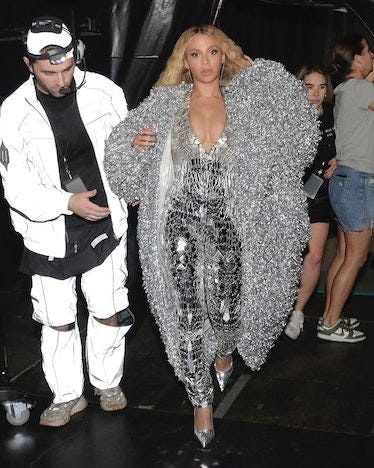
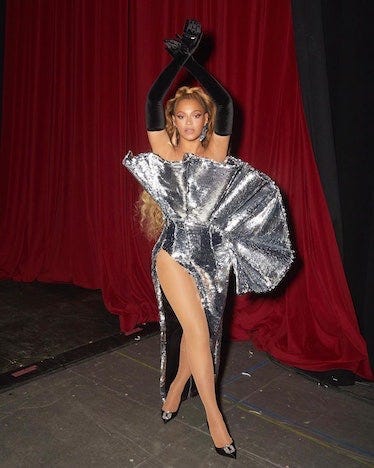
One of the clearest ways to see that, in addition to queer communities, the Harlem Renaissance was absolutely on Bey’s mind when she created RENAISSANCE is through her fashion choices during the RENAISSANCE tour.
Beyoncé had experimented with Harlem Renaissance-inspired looks as early as 2016, and her mother Tina appears on the poster for a “Harlem Nights: Wearable Art” event that took place on 22 October 2022.


This event was explicitly intended to imagine and indeed create a future Black Renaissance, which was framed in terms of a future version of the Harlem Renaissance past. And you can bet that Beyoncé was behind the scenes timing it all very deliberately. Check out a bit about that event here:
In terms of the RENAISSANCE concert tour, the set pieces at times reflected a futuristic aesthetic sensibility strongly reminiscent of Aaron Douglas’s paintings.


Beyoncé also wore zoot suit-esque pants that evoke the flamboyant fashions of the Harlem Renaissance in general, as well as iconic musicians such as Cab Calloway in particular.
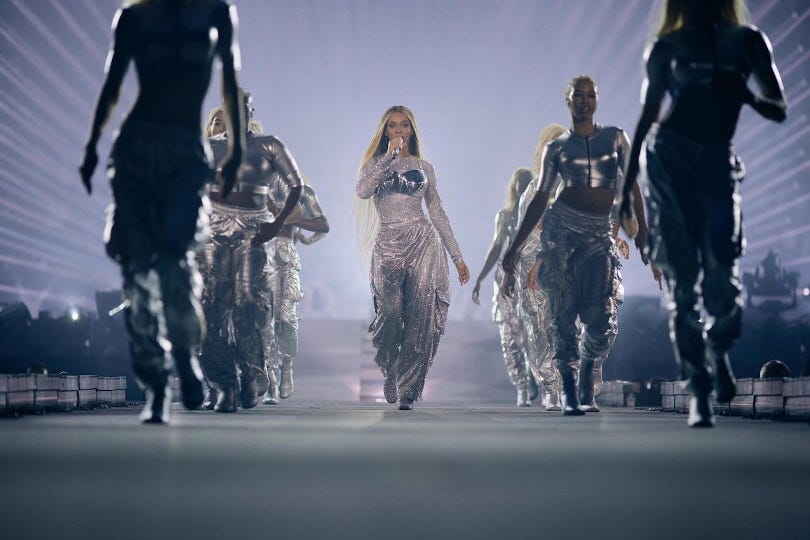
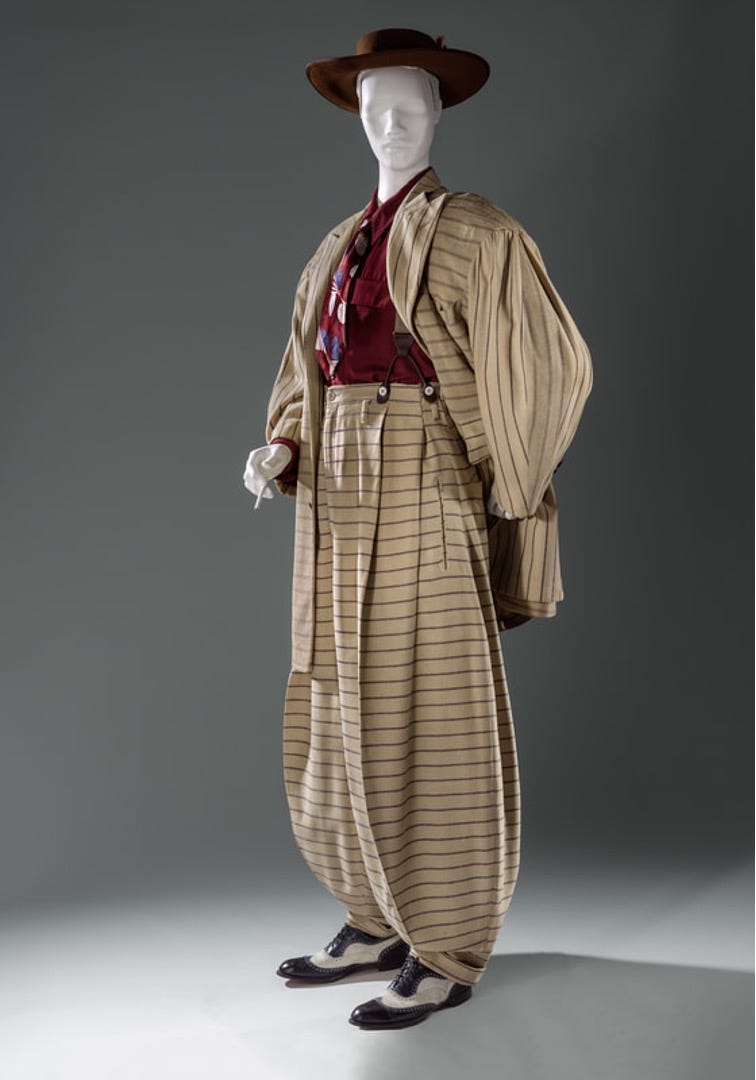
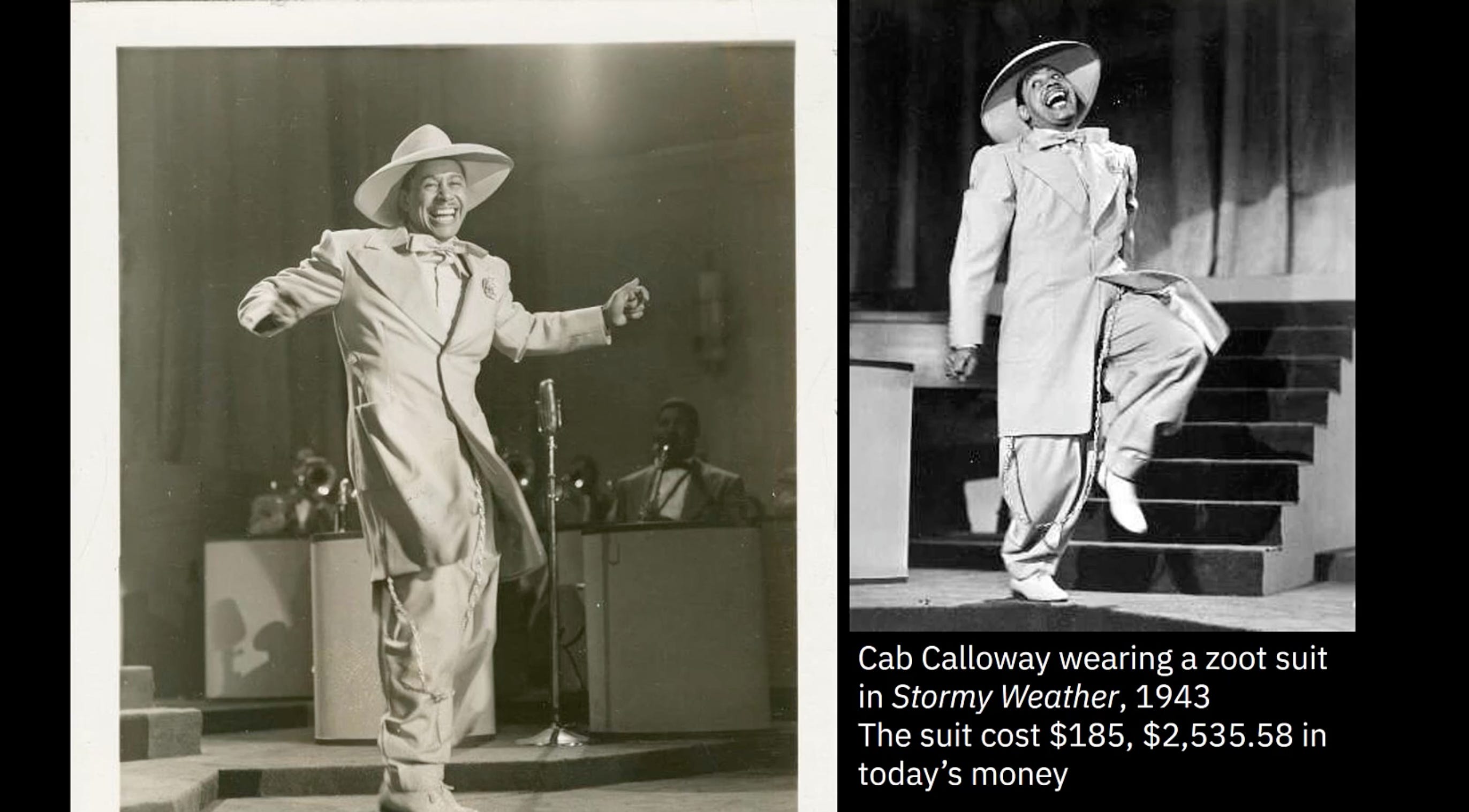
Zoot suit pants were pegged (full in the legs, then tapered to a tight cuff) intentionally, to facilitate active dancing – and Bey looked frickin’ fantastic in them, recreating intense Tik Tok dances from kids half her age.
On Juneteenth, aka 19 June, aka the date of the Emancipation Proclamation, aka the pronouncement by President Abraham Lincoln that 3.5 million American Black people were now freed from official slavery, Beyoncé upped the ante by wearing exclusively Black designers.
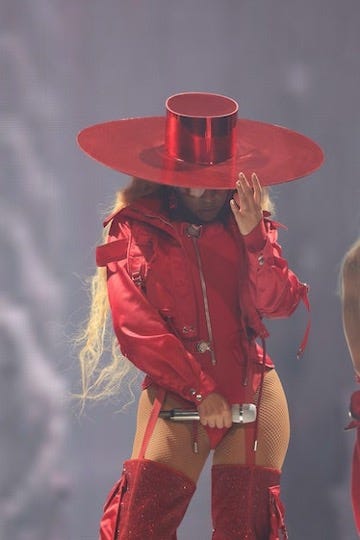
In this Juneteenth look, Bey’s hat reflects Harlem Renaissance aesthetics. She often also wore ensembles that gave an “it should cost a billion to look this good” version of many outfits seen in the Paris Is Burning balls.
5. “Don’t Even Waste Your Time Trying to Compete with Me”
As a 90s kid growing up on L7, Dead Kennedys, and The Cure, I had exactly zero interest in the early Beyoncé. But everything changed with the 2013 drop of her self-titled album. Overnight I realized I had been ignoring not just a formidable musician and woman, but also a formidable artist. My favourite artist of all time is actually the fashion designer Alexander McQueen, so I’m no newcomer to the idea that applied art, pop-culture art, billion-dollar-industry art can still be “art”; I was just new to Beyoncé.
Beyoncé’s outfit on the opening night of the RENAISSANCE tour was chosen very deliberately from the house of Alexander “Lee” McQueen, an immediate nod to the best of queer fashion design.
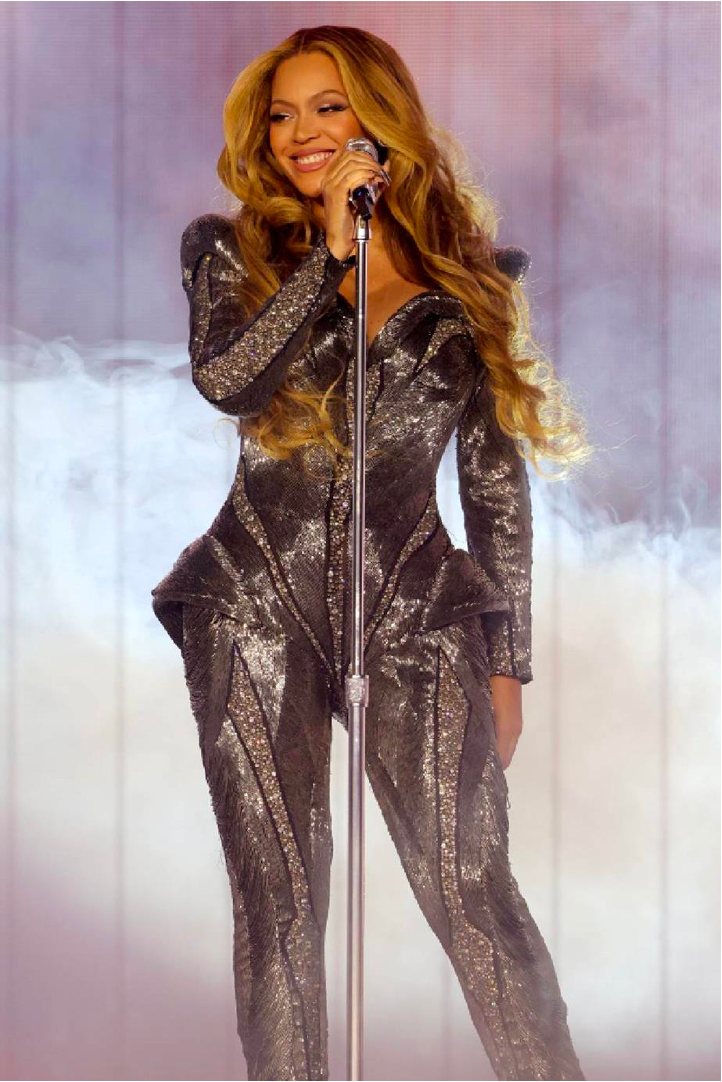
McQueen, quite possibly the most controversial fashion designer ever, won the British Fashion Award an unprecedented number of times, winning British Designer of the Year in 1996, 1997, 2001, and 2003 and is a very meaningful, poignant artist for gay and queer folks.
McQueen achieved peak fame as Beyoncé went from being a young teenager to a grown woman, and she wore McQueen multiple times during the RENAISSANCE tour.
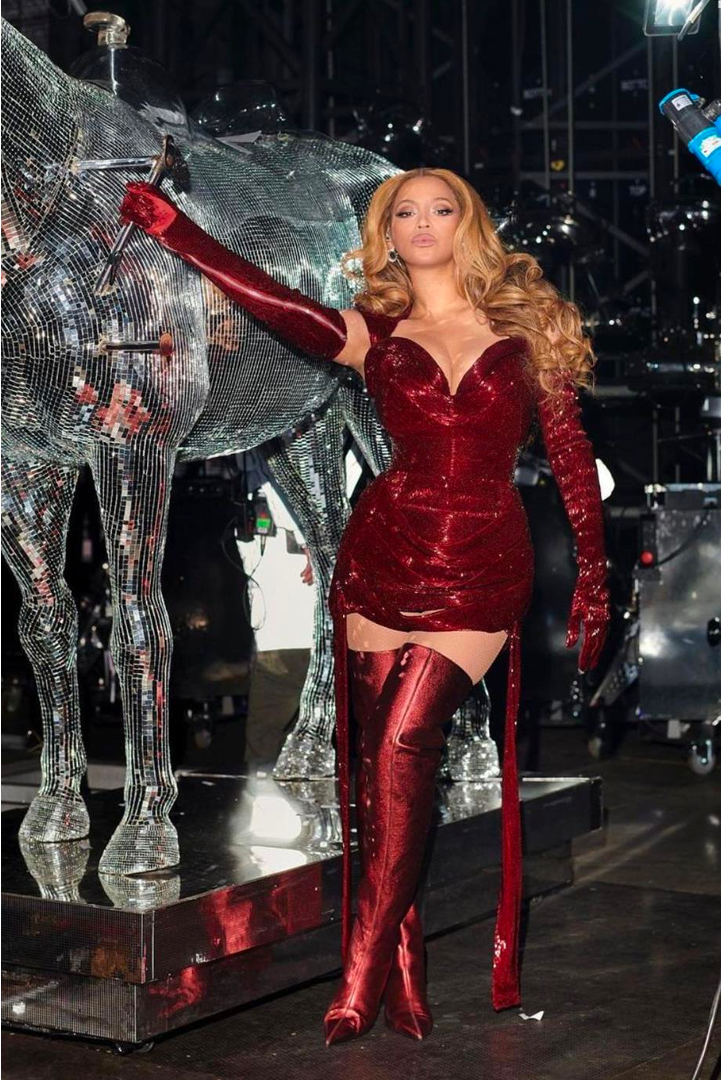
Beyoncé’s adolescence is indeed part of the point of this album, too, since it’s dedicated to her uncle Jonny, a proud gay man who had a huge influence on the young Bey. RENAISSANCE is inspired by Jonny and other brave queer-culture creators; “all of the fallen angels whose contributions have gone unrecognized for far too long.” Her full dedication was: “A big thank you to my uncle Jonny. He was my godmother and the first person to expose me to a lot of the music and the culture that serve as an inspiration for this album. He lived his truth. He was brave and unapologetic … Thank you to all of the pioneers who originate culture, to all of the fallen angels whose contributions have gone unrecognized for far too long. This is a celebration for you.” Another way of interpreting her saintly suspension at the end of the show I saw would be as an angel; by incorporating all these different ideas, eras, and aesthetics Beyoncé gives them new life, spotlighting them and raising them back to the heights they deserve.
6. “Have You Ever Had Fun Like This”
On a musical level, one of the most impressive aspects of the RENAISSANCE tour was how Beyoncé deliberately and masterfully created it to be entertaining for anyone and everyone. If you didn’t know Beyoncé at all but had just ended up in a $11,000 seat in, say, Toronto on 8 July because of the kind of company you keep, you could still follow and enjoy the show. If, on the other hand, you were a die-hard fan – like me and the people in the absolute last row of the stadium behind me – and you sang along you could stay on beat through every mashup, medley, and transition for hours. That’s how *flawless* she is.
This was the setlist for the show I saw:
“Opening Act”:
1) Dangerously in Love
2) Flaws and All
3) 1 + 1
4) I’m Goin’ Down (Mary J. Blige cover)
5) I Care
6) River Deep, Mountain High (Tina Turner tribute)
“ACT 1: WELCOME TO THE RENAISSANCE”
7) I’m That Girl
8) Cozy
9) Alien Superstar/Sweet Dreams mashup
10) Lift Off (Jay & Kanye cover)
A recorded version of 7/11 played while ACT 2 was being set up.
“ACT 2: MOTHERBOARD”
11) Cuff It
12) Energy
13) Break My Soul
“ACT 3: OPULENCE (flashing lights rotated between the words OPULENCE & BEYONCÉ)”
14) Formation
15) Diva/Countdown mashup
16) Run the World (Girls)
17) My Power (Lion King)
18) Black Parade (Lion King)
19) Remix of Savage (Megan Thee Stallion cover)
20) Partition
“ACT 4: ANOINTED”
21) Church Girl
22) Get Me Bodied
23) Before I Let Go/Freakum Dress mashup
24) Rather Die Young
25) I Want You Back (Jackson 5)/Love on Top
26) Crazy in Love
A recorded version of a Green Light/Freedom mashup played while ACT 5 was being set up.
“ACT 5: ANOINTED, PART 2”
A recorded version of Diana Ross’s Long Hangover was played first.
27) Plastic off the Sofa
28) Virgo’s Groove
29) Naughty Girl
30) Move
31) Heated
A recorded version of Already, from the Lion King soundtrack, played while ACT 6 was being set up.
“ACT 6: MIND CONTROL”
32) America Has a Problem
33) Pure/Honey
ENCORE:
34) Summer Renaissance
7. “I’m One of One; I’m Number One; I’m the Only One”
It seems somehow redundant to even review the RENAISSANCE concert, really; obviously it was the most visually
stunning thing I had ever seen. And I’ve seen a lot of things. Besides what I’ve already mentioned, she also honoured Grace Jones, who features on the RENAISSANCE song Move, by including visuals that directly referenced Grace Jones’s vampire cult classic, Vamp (with art by Basquiat). And of course there was a seemingly endless procession of different kinds of space and technology imagery – although I feel like claims about Bey’s critiques of AI, or homages to the classic Fritz Lang movie Metropolis, have been both overplayed and underwhelming. I believe the space imagery in RENAISSANCE worked to convey the importance of a specific kind of futurity: Beyoncé is imagining a future Black Renaissance; she’s proposing a place without sex- or gender-based discrimination; she’s creating a place where everyone is free.
8. “Poppin’ Our Pain and Champagne through the Ceilin’”
In a reference to the Jay-Z/Kanye song that Beyoncé herself features on, during the concert she sang, while hovering in space, “you’ll never know what we did to make it this far.” When it comes to Black American history and/or LGBTQIA2S+ history that’s probably correct. But as far as the RENAISSANCE tour itself goes, we can at least learn a little more about what was done to make it this far when the RENAISSANCE film is released on the first day of December.